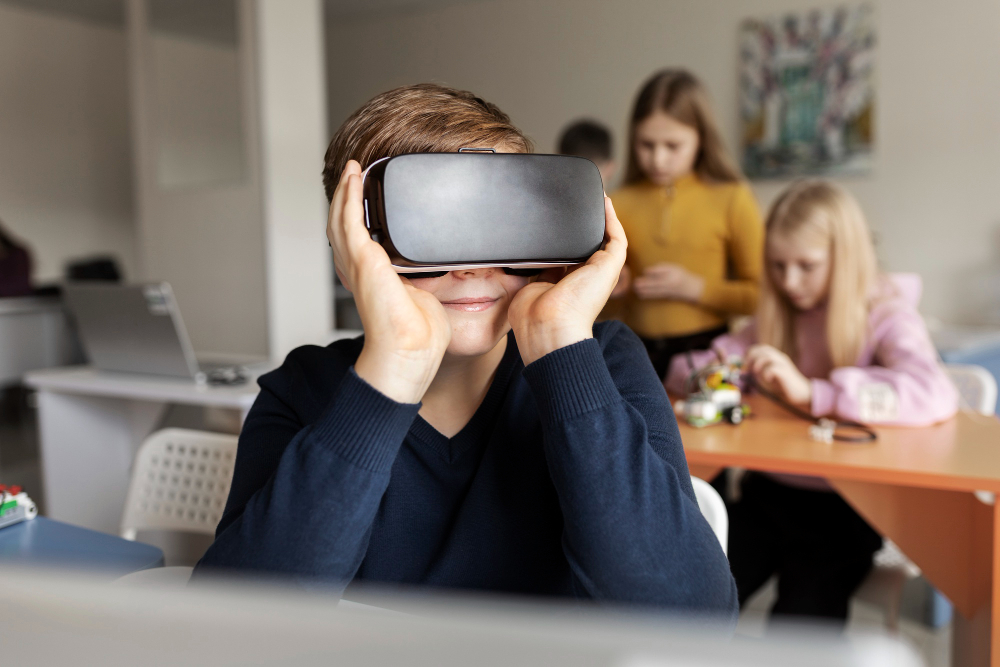
Technological innovation has radically transformed different aspects of our daily life in recent decades, and in particular, the technologies of virtual reality (RV) and increased reality (RA) are emerging as revolutionary tools in sectors as diverse as education and the business world. These technologies not only offer immersive experiences, but also open new doors to creativity, efficiency and personalization, creating unprecedented opportunities to improve the way we learn and do business.
Exploring the potential of virtual and increased reality in the educational field
Education is one of the sectors that has benefited most from progress in virtual and increased reality. These technologies are changing the way students interact with knowledge, facilitating educational experiences that, until recently, were unthinkable within a conventional classroom.
Immersive and personalized learning
Virtual reality allows students to be immersed in simulated environments, where they can explore historical scenarios, perform complex scientific experiments or visit remote places without leaving the classroom. For example, through an RV experience, a student can walk through the streets of ancient Rome or take a virtual tour of the Solar System, expanding his understanding and promoting a genuine interest in learning.
On the other hand, the increased reality complements that experience, overtaking digital information about the real world. This is particularly useful in disciplines such as medicine, engineering or architecture, where students can visualize 3D organs, structures or projects, interacting with them intuitively. The RA also allows you to adapt content to different styles and learning rhythms, offering highly personalized experiences.
Accessibility and skills development
Another significant advantage is the possibility of providing quality education in remote regions or with limited resources. The availability of RV and RA devices, along with digital platforms, can reduce geographical and socio-economic barriers, providing all students with the opportunity to access high quality content.
These technologies also promote the development of practical and reflective skills, enhancing skills such as problem resolution, creativity and teamwork. RV simulators, for example, allow students to practice dangerous or costly situations in a safe and controlled environment, preparing them for reality.
Innovation in business through virtual and increased reality
The impact of virtual and increased reality is not limited to education; in the business field, these technologies offer a fertile field for innovation, differentiation and competitiveness in constantly changing markets.
Improving customer experience
In the world of trade and marketing, the RV and RA allow you to create immersive and memorable purchasing experiences. From virtually testing clothes to visualizing what a furniture would look like in the house before acquiring it, these technologies help customers make informed decisions and increase their satisfaction.
The brands that implement these tools can offer virtual tours of their facilities, product demonstrations or interactive events online, thus capturing attention and fidealizing their audience in an increasingly digitized environment.
Optimization of internal processes and training
At the domestic level, companies are using RV and RA to train their employees in complex or dangerous procedures, minimizing errors and reducing costs associated with traditional training. For example, in sectors such as manufacturing, aviation or health, these simulated environments allow employees to practice skills in a safe environment, accelerating skills acquisition.
In addition, these technologies facilitate remote collaboration through shared virtual environments in which geographically dispersed teams can interact, solve problems and design real-time joint solutions.
New business models and market redefinition
The virtual and increased reality also opens the way for disruptive business models and completely new business modalities. Innovative companies are offering entertainment experiences, virtual tourism, personalized training and even remote health care, expanding their reach and creating new income opportunities.
For example, virtual reality platforms for events allow you to participate in concerts, fairs or conferences without moving, eliminating physical and economic barriers. Thinking about these technologies as an integral part of business strategy can be the key to distinguishing in saturated and highly competitive markets.
Conclusion
Virtual and increased reality represent the future of a world in which digital interaction and immersive experience become an essential part of learning and business activity. These technologies are transforming the way we acquire knowledge, develop skills, serve customers and manage internal processes. The intelligent and creative adoption of these tools can make the difference between organizations that are at the forefront and those that are lagging behind in an increasingly digital and dynamic environment. The key is to understand its potential and bet on its integration into every aspect of educational and commercial development.